miércoles, 5 de abril de 2017

Conclusion | Literary Criticism

Conclusion
Hello everybody, welcome to the conclusion of my project about Literary Criticism. It is nice for having you right here. I hope you enjoyed this blog as much as I did.

During my project I leanrt many important things. I read books/stories that I never imagine could exist. I really like the fact that most of them are related to real life situations. I am not a frequent reader; it is something that I am not accustomed to do. Now, I have a different perception of books. I personally think that when you read a book, you are learning important lessons for life. Certainly, stories teach us lessons. I have been in many places and different situations apart of my life, through readings.

I have no words to thank my mentor teacher in this project, Danielle Traverse. She is such nice person. She always tells me about the importance of reading and enjoy what we read. I can see it is true. You will never lose time when reading, unlike, you will feed your brain and knowledge. I have acquired a lot of important information that will help me during my life. I have learned how to criticize literary works. Literature goes far than reading a book. I discovered how wonderful is “the world of readers” and literature lovers.

I would like to continue my blog. If you want to read more of my entries, fell free to leave on the comments any suggestion and I will read it. My blog is yours too.

This has been such an amazing experience. I hope to see you soon, guys.

-Bell Solís


A Doll's House | Feminist Criticism

A Doll’s House

By Henrik Ibsen

Hello everybody, nice to see you again. For today we have a feminist criticism about “A Doll’s House” by Henrik Ibsen.

In this play, Ibsen shows how women were treated back then. Society has changed in a high percentage of those retrograde thoughts. Nowadays, women have equal opportunities as men. Women study and are well-prepared. We are allowed to work and earn our own money. Of course, when I say “allowed” does not mean we were not able to do it back then. When Ibsen wrote this play, he was sure about the fact that Nora represents a real life situation. If you have not read the play yet, I recommend you to do. Otherwise, you might have some misunderstandings with entry. In A Doll’s House you can see that Nora’s life is not free of choices and personal opinions. Her decisions are not important as his father or husband. They take the control of her life. She is always at home taking care of her three children, with no money to do something that she desires.

From my personal point of view, Nora projects the life of many women back then. She sacrifices herself to get money and help her husband recovering from his sickness. She does this action, keeping it as a “big secret”. There is no way to justify it. She knows that it was “a bad action” and the only ones that are “able” to take decisions are men. Besides that, Nora is a good example to see how women were seen as puppets for men. Long time ago, a woman should be at home, taking care of children, with no social life and were not allow to express opinions. That’s why, throughout the play, Nora realizes she will never be happy. Because she is full of debts and she is like a puppet. She has no a normal life. Besides that, there is not anything that can fulfill her heart and happiness. She is living a torture and a stressed life.

Nora is not allowed to take decisions by herself. But, at the end of the play, she takes one final decisions and for me, the most important. Of course, it is not simple, but she has no choice. She decides to leave her house and family. We are not talking about her husband only, but her three children. She has a little baby who needs her. Back then, this situation was not a common thing. It was rare to happen. She discovers that her life is more important than anything else. And “life” is not living. Life is being happy, loved, satisfied and thankful for everything we have. Clearly, Nora lacks of “life”. She is very brave to take that important decision, but she deserves happiness.

Now, I want to know what is your point of view about the situation presented in the play.
1.     What would you do if you were in Nora’s position?
2.   Is happiness important to survive in this life?

Attached a link to a website with a detailed summary about the play A Doll's House
If you want to watch the movie, here I attach a link to a movie of the play.


See you guys!
-Bell Solís

Charlie and the Cholate Factory | Structuralist Criticism

Charlie and the Chocolate Factory

By Roald Dahl

Hello everybody! Nice to see you again. For today, we have a structuralist criticism for Charlie and the Chocolate Factory by Roald Dahl, published in 1964. 


If you have not read the story and you cannot find the book, I recommend you to watch the movie. In the movie (in which the protagonist is Johnny Depp as Willy Wonka) you will have a general idea about the story. The difference between the movie and the book is that the movie is focused on Willy Wonka, and the book is focused on Charlie, a poor little boy (the original story is based on that).


The story has two sides. First of all, we have the focal point of the story. Charlie and his family. Charlie is a little boy, who lives a small house with all his family. “All his family” means that he lives with his parents, Mr. & Mrs. Bucket, and his four grandparents. Yes, they all (seven people) live in the same small house. Besides that, they are poor, the only one who works is Mr. Bucket. He works in a toothpaste company and he does not earn a lot of money to provide a good life conditions for everyone. Charlie, is a nice and normal boy. He always hungry. He loves chocolate and likes to study. On the other hand, we have Willy Wonka. Wonka is the owner of an “ENORMOUS CHOCOLATE FACTORY!”. Which is located in Charlie’s neighborhood.

From my personal point of view, the story projects a real life situation. Charlie reflects the life of many little poor kids. He likes chocolate and he desires to eat chocolate. The sad reality is that he just receives chocolate on his birthday (He eats the chocolate in tiny pieces, to make it last for a month). On the other hand, the chocolate factory is reopening, and Wonka is giving the opportunity to five children to visit the factory if they find a golden ticket in the chocolate bars. 


Of course, to find a golden ticket, Charlie needs money. But, Charlie has something more important than the order four kids. Charlie knows how hard life is. He has faith and hope trying to find the golden ticket. That’s why, with those simple and essentials things, he found the last golden ticket to visit the factory with his grandpa Joe. At the end, Charlie won the enormous chocolate factory of Willy Wonka. The story teaches us a lesson, if you have a dream, go and fight for it. As you see, Charlie does not have enough money, but he has something more important than money. It depends mostly on your attitude towards your dream. Keep positive, and working hard for that. At the end you will have the best reward of your life, and it will be the opportunity to achieve your dreams.

Guys, I want to know what is your opinion about this story. I also have a question for you:
Do you have any dream that you would like to achieve?

Attached a link to a website with a detailed summary about Charlie and the Chocolate Factory

See you later!
- Bell Solís

miércoles, 29 de marzo de 2017

Where Are You Going, Where Have You Been? | Psychoanalytical Criticism

Where are you going, where have you been?
By Joyce Carol Oates


Hello everybody! This is a psychoanalytic criticism for Where are you going, where have you been? By Joyce C. Oates.

According to Oates, the story was inspired in a real life situation that happened in Tucson, Arizona in 1996. There was a serial killer, Charles Schmid who committed a triple crime. He was an obsessed adult that killed three teenagers. This sad new inspired Joyce to write the story. Oates dedicated her story to Bob Dylan, because his song “It’s All Over Now, Baby Blue” helped her to write the story.

In “Where are you going, where have you been?” we can find a common and special situation. The protagonist, Connie, she is a young lady pretending to be an adult. She acts like a “mature” person with a teenagers’ thoughts. The relation between Connie and her parents is not good at all. I mean, you might agree in this, in the adolescent we look for acceptance. At those ages, we do not have a defined personality and clear ideas about what we really want. She is trying to be a “popular girl”. Connie is a beautiful lady, everybody knows that. But she forgets something important, being “popular” and beautiful for everybody (including adults, with a big difference between the ages of them and her) can give Connie many problems.

In the story, there is a character, Arnold Friend. He pretends to be a teenager saying he is 18 years old. But the reality is that he is over 30. This guy starts to get obsessed with Connie. He knows many things of her life and family. He has serious intentions against Connie. From my personal point of view, the story gives an open imagination for the ending. At the end, we do not if he wanted to rape Connie or just killed her. If you take into account, Oates’ inspiration, we can see that Charles Schmid (the serial killer) is represented by Arnold Friend in the story. So, was Arnold out of control to kill Connie? During the story, there is an innocent girl acting with vanity and obsessed with her appearance. There is also a man, taking advantage of that innocent to commit a crime. We do not what he is pretending with Connie. Is it to rape her or to kill her? Both are crimes.

The story is reflected in real life. We have young ladies acting like adults. They do not enjoy their adolescent as they should. The way they dress or the make-up they use to impress others is really worrying. The use of social media is getting out of control. People upload everything on internet; personal photos, videos, locations. We do not who is in the other side of the screen studying and analyzing our lives. We should protect our image and privacy. Our personal life should be protected.


Now guys, I want to know what was your reaction after reading the story.
 What do you think happens at the end of the story?
 Do you have any recommendation for teenagers?

Attached a link to website with more information about Where Are You Going, Where Have You Been?

See you later ;)
-Bell Solís


The Rocking Horse Winner | Formalist Criticism

The Rocking Horse Winner
 by David Herbert Lawrence


Hello everybody! For today, I bring a “formalist criticism” for you, about this story by D. H. Lawrence.

In The Rocking Horse Winner, we can agree and defer with many points of view. For my personal point of view, this story was written with a projection about “the future” living the same really that David was living. I really like this story, because I can relate real things with it. The reading presents a family, a couple that has three children who live in a decent house with good furniture. They do not lack money and essentials things to live well. On the other hand, this woman, wants to project her life as “the worst situation in life” because she lacks of money. Besides that, we can see a “Mother” who is so selfish. Everything Hester wants in her life is money. She does not give love to her children and does not take of them. That is why, the youngest in the family, Paul, starts to ride his rocking-horse to earn money and please his mother.

I personally belief, there are a lot of parents (fathers or mothers) who prefer money and a good life, instead of their children. In The Rocking Horse Winner, we can learn a good lesson for life. Paul, the young boy, wants to see his mother happy. The way he found to make it possible, was through his rocking-horse. Hester always complains about her unlucky husband and the “lack” of money in the house. She thought that money could give them a “happy” life, full of love and desires. She forgot how to be a good mother. Paul, in his innocence, has a “lucky” life. He has good predictions about the horse races using his toy. Paul earns a lot of money by betting in the races. The boy has a goal, “make his mother the happiest”. He spends his life, making predictions in his rocking horse, until he died because of overthinking.

Until this moment, Hester the mother, realize that her selfish life and desires have killed Paul. She knew that money could fill her house, but without a son, there was nothing that could fill her life and her empty heart.

Now guys, I want to know a personal critic from you, towards the story.
  • Is it something that happen in real life?
  • What do you think about the death of Paul?


If you have not read the story yet, here I attach a website with a summary in detail about The Rocking Horse Winner

See you guys,

-Bell Solís

Beowulf | Mythological Criticism


Beowulf

(unknown author)


   Hello everybody, thanks for being here reading my blogs once again. For today we have a Mythological Criticism for Beowulf.

Grendel's mother
    Beowulf was first created as a poem (a really long poem). There is a good movie for this poem, I recommend you to look for it and watch it. Beowulf has an unknown author, but many people claims that it was probably based on real life. In this poem, you can find a lot of important details that make it interesting. From my personal point of view, there are many aspects in which I defer, because those are beliefs that we do not have now. First of all, we have the conflicts between the king and the creatures. There are two mythological creatures fighting against the kingdom, because they (Grendel and his mother) pretend to destroy the king Hygelac. But, once Grendel is killing the soldiers from the kingdom, he cannot attempt against the king Hygelac (because he is his father). Yes, guys, that sounds weird. They are mythological creatures; how could that be possible? We can find in many stories written many years ago, the existence of these type of “living creatures”. My argument here is, if they were not humans, how they had a son (Grendel). In the past, these creatures were just like a “curse” for people.

Grendel

   On the other hand, we have Beowulf, who is the king’s nephew. He is considered the hero in this poem. Beowulf is a warrior that possess enormous strength and courageous to confront the monster (I want to make emphasis in “enormous strength”). Now, we do not have people with those “special powers”. This hero defeated Grendel and his mother, but there is actually one more thing. He got charmed by the lady and they had a son (a Dragon). Grendel’s appearance is not described at all, but he has some similarities with humans, with horrible aspects. Beowulf’s son, is a Dragon. Today, we can find this creature in many recent movies, but we do not have evidence of their actual existence. The same happens with “the hero”. His son (dragon) wants to destroy the kingdom and kill Beowulf. At the end, Beowulf, the hero dies saving and protecting innocent people from the kingdom.
Dragon
    Regarding some archetypal criticism, I want to share some with you based on the movie. We have “water”, it represents birth and life. Grendel’s mother lives into a lagoon. There is a lot of “blood” during the movie, it represents the sacrifice of many warriors protecting the kingdom. We have number three, it represents unity and power. There three creatures; Grendel and his mother, and the Dragon. There is a hero, Beowulf. And there is finally, a sacrificial scapegoat, when Beowulf, the hero, dies to save his people.

Now guys, I want to your points of view about this poem/story.
How can you relate this story with real life?

Attached a short summary video about Beowulf (click here)

See you later ;)
-Bell Solís 

miércoles, 22 de febrero de 2017

Brave New World | Sociological Criticism

 Brave New World
by Aldous Huxley

Aldous Huxley
Hello everybody! For today we have a Sociological Criticism for Brave New World by Aldous Huxley. 

    Brave New World was published in 1931 by Aldous Huxley. This novel show how a “world population” is divided in categories and created and controlled through the use of high advanced technology. The main controller is called “The Director”, who works in the Central London Hatching and Conditioning Centre. There are a group of young students visiting the “World State” to learn about the fertilizing room. We can compare those guys with us. The reading takes us through the student, seeing how the world would be in the future because of the excessive use of technology. The fertilizing room is the place where “humans” grow up inside bottles to be taught by hypnopedia that society’s worth should be always over people. 

   In the world state, humans are divided into several castes: Alphas, Betas, Gammas, Deltas and Epsilons. The divisions are according to the physical appearance which is wrong. They want people to be differentiate by colors and labels. Alphas citizens are one of the best ones. They are intelligent, tall and have a good physical shape. Gammas are stupid and wear green and Deltas wear light brown. Epsilons are the worse, they’re ugly and wear black.


Brave New World is a future controlled and sterilized society that reflects a different world without sensitivity, morals and education. Aldous Huxley related the novel with some aspect of his personal life. He was addicted to Hallucinogenic Drugs. In the reading, they use a drug called “Soma”. Also, the world is projected with an “open mind” with no taboos. Children grow up in a sexual environment which is not good for them. The word “sex” and the practice of this, is something normal for them. Besides that, the divisions of the humans are a way to practice discrimination. Alphas are the best ones; they are “perfect”. On the other hand, Epsilons are considered as the worse of the world state. Nobody want to play with them, because they are ugly and fool. 

I want to know your opinion about “Brave New World”. Consider you are living in this World State and you have the “POWER” to change things.

         1.  Would you accept a world with divisions?
               2.   What would you like to change?

Here I attach a link to a website with a detailed summary about Brave New World

See you soon!
-Bell Solís


Harrison Bergeron | Traditional Criticism


Kurt Vonnegut
       HARRISON   BERGERON

      by Kurt Vonnegut


Hello everybody! Here you have a traditional criticism for “Harrison Bergeron”.
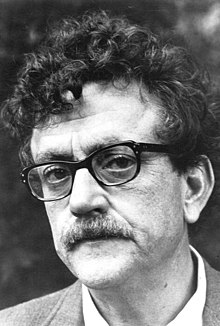
Kurt Vonnegut was born on November 11th, 1922 in Indianapolis. He was an American writer, best known for his satirical literary style, as well as the science-fiction elements in much of his works. He belonged to a wealthy family in Indianapolis. He died on April 11th, 2007 in New York City, at the age of 84.

    In “Harrison Bergeron”, there is a way to reflect the future coming. In this story, we have two different ways of seeing “life” in this world. First of all, we have our reality. There are many differences between people: beauty, weight, height, personality, and occupations. We live all together, with no divisions or categories, no matter the physical appearance. Besides that, we face a lot of differences between countries. There are wars, poverty, unhappiness, insecurity and we are exposed to any dangerous circumstances. On the other hand, in “Harrison Bergeron” there is a crucial situation that reflects “technology” as the future controller of our lives. Making divisions, changing people’s thoughts, personalities, and perspectives. Technology through a kind of government (or a group of special people) is taking the control of everything. They want to treat us like “puppets”. That’s why is a connection between the reading and the image that Vonnegut used to represent his story.


    The story shows a different “life”, and it points out for the future that comes. He opens the story with this descriptive narration about social equality in the future.

“The year was 2081, and everybody was finally equal. They weren’t only equal before God and the Law. They were equal in every which way. Nobody was better looking than anybody else. Nobody was stronger or quicker than anybody else. All this equality was due to the 211th… Amendents to the Constitution, and to the unceasing vigilance of agents of the United States Handicapper General”.


    In the story, the case of “Harrison Bergeron” is special. He is a different young boy, that wants to have the control of his own life. He is different in all ways. He is an intelligent handsome boy that fights for his freedom and acceptance by the society. The world showed in the story is of “equality”, privated of liberty and personal decisions. There’s a change of the reality we live now. Our society enjoys freedom of thought, intellectual ability, physical beauty and strength, but is being manipulated through the use of technology and by government decree. That’s a nice story that presents the “real life” for the futures years. Sadly, we are becoming puppets of technology. Development and advanced technology have been taking the control of our life. A world of equality controlled by a “government” with lack of freedom and personal thoughts. The story presents a change in everything. From my personal point of view, life is perfect, but it’s true that hard times are coming and nobody can change that. Vonnegut published this story in 1961, but he was sure that this destructive phenomenon called technology would take the control of our lives and make us “equal”.

Now, I have a question for you to know what you think about this story:
Is there any "reality" in the story related to the control of technology in our future lives?

Here I attach a link to a web site with information and a short video of 
"Harrison Bergeron"

See you soon! 💁
-Bell Solís

CRASH | Movie Analysis

Resultado de imagen de paul haggis
2013
Paul Haggis - 2013


                         CRASH

                          by Paul Haggis


He was born on March 10, 1953 in London, Ontario, Canada.
He lives in Santa Monica, California
Canadian director, screen writer and producer. He is atheist.
He won the “Best Picture Oscar” twice: Million Dollar Baby (2004) and Crash (2005).


CHARACTERS:


Rick and Jean Cabot
They are married. He is the white District Attorney of L.A. She doesn’t work, unhappy girl who has everything
Peter and Anthony
They are friends. Afro-Americans. They steal car to get money by selling them. They belief that society is against black people. They stole Cabot’s car
Cameron and Christine Thayer
They are married. Afro-Americans. Cameron is a television director. Christine grow up in a more privileged environment than other African Americans
Officer John Ryan
White police officer who hates black people. His father is sick.
Officer Tom Hansen
He hates racism and stereotypes. He likes to help black people.


White people are seen as the well-educated population, with a good economic situation and high status. Black people are seen as the poor population, with a bad life quality and they suffer from racism. White people have the power over Afro-Americans

The “Great American Dream” is not what is expected. Moving to U.S.A is hard decision, people should be prepared for the worst. At the beginning it turns difficult, and having a good life takes time.

Crash expresses the racial and stereotypical prejudices that every ethnicity and race experience in everyday life. The mood of the movie is definitely hostility. The characters are pushed into very uncomfortable situations.


The tittle is significant for the movie because we encounter all types of races and ethnicities in everyday life. It’s as if the encountering is us “crashing” into each other. If a person is racist, it will find the way to let everyone notice it.


I want to know what you think about this movie, here you have a questions:
Does the movie teach you something? Why?

Here I attach two links to the movie: Crash (YouTube) and Crash (Netflix).

See you!
-Bell Solís

miércoles, 8 de febrero de 2017

Thank you, M'am | Traditional Criticism

    
Langston Hughes 
 THANK YOU, M’AM
by Langston Hughes


Hello everybody! For today we have a Traditional Criticism about Thank You, M’am by Langston Hughes.

   In "Thank you, M'am", there are many factors that affect that little boy and take the humanist view. This story is about a young boy called Roger, who stole a purse of an elderly woman. The boy was about fourteen or fifteen, he did not realize that action could be that much bad. It was around eleven o'clock at night. What was doing that young boy in the street at night? The reason of why he stole that purse was because he wanted money to buy a pair of blue suede shoes. Probably, this woman could have punished and took him to the Police Office. But the reality was totally different. She took him to her house, she helped Roger and gave him food. The good action from this woman, Mrs. Luella Bates Washington Jones, teach us that there is always a deep reason of the bad actions people do. M'am threated him in a nice way, even though this boy tried to snatch her pocketbook, she discovered he just wanted to buy a pair of shoes and he didn't thought he was affecting someone else to get what he desired. 


   Throwing back long time ago, the situation of African Americans in USA was quite difficult. They were discriminated and bullied. There was a lot of racism and xenophobia for black people. The economic situation was awful, Afro-Americans were bad paid, with a low life quality and not well-educated and prepared in studies. Besides, Roger's parents couldn't give him money to buy a pair of shoes and they didn't care about him, because it was too late that night for a young boy walking down the street. Probably, Roger wasn't taught that stealing someone else's things was wrong and that getting money in that way could end in jail. In the 1900's, Afro-Americans were full of poverty, discrimination and bad qualities conditions. Roger was a little boy with a single and normal desire at that age, he just wanted a pair of blue suede shoes. At the end of the story, M'am gave him money and left him go. She had a sensible heart and treated him in the best way she could. Mrs. Luella understood his situation because she knew how was his life condition, and she saw her childhood in through the eyes of that little Roger. I really like the decision she took towards the situation, she taught him a lesson in a very suitable way.


I want to know what you guys think about this nice story of the 1900's in USA

Here you have these questions

1. What would you do if something similar happens to you? 

2. How do you think were Afro-Americans' situation in those years?


Here I attach a link to a website with more information about this story:  "Thank You, M'am" 

See you!

-Bell Solís.